
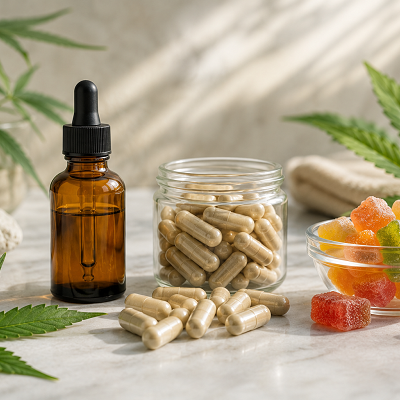

CBD Oil vs CBD Capsules vs CBD Gummies: Which Is Right for You?
You enter a health store anywhere in the United Kingdom or go to a CBD company’s website, and you will see that most brands are selling the same product — cannabidiol (CBD) — in three very similar formats: CBD Oil, Capsules and Gummies.
There seems to be no difference between them, based on the way they are marketed — like choosing from a variety of different flavors of ice cream. However, this is not true. This article will discuss the differences between these three primary forms of CBD products — Oil, Capsules and Gummies. We will also provide some recommendations about the best form of CBD products for each type of treatment.
The Core Variable: Bioavailability
Bioavailability is perhaps the most significant factor when comparing formats. It is defined as the portion of the consumed substance that reaches systemic circulation (and thus has an effect). CBD’s bioavailability can vary significantly based on the method of consumption:
- Bioavailability of Sublingual Oil: 20-35%
- Bioavailability of Swallowable Capsules or Gummies: 6-19%
- Bioavailability of Inhaling Vape Products: 34-56%
This means in terms of actual amounts delivered to your blood stream, taking 25 mg of CBD via sublingually administered oil, will deliver approximately double the CBD into your system compared to taking 25 mg via swallowable capsules. That is the single greatest practical difference when moving from a format to another. If you reduce dosage by half after switching from oil to swallowable capsules, you may find your expectations for results are reduced accordingly.
💧CBD Oil: The Most Flexible Format
CBD oil is administered by placing drops under the tongue and holding for 60 – 90 seconds. This allows for partial absorption into the body via the sublingual mucosa (under the tongue) and therefore avoids first-pass metabolism in the liver. Any remaining drops will be swallowed and treated the same as capsules.
The advantages of using CBD oil:
- highest bioavailability of all oral options; more CBD in your system per milligram consumed
- fastest onset of all non-inhaled formats; absorption from the sublingual mucosa begins within 15 minutes and peak effects are seen at 30 – 60 minutes after use
- most flexibility in dosing; drops can be adjusted in small increments making it easier to find your optimal dosage than with fixed-dose products
- full-spectrum & broad-spectrum oils contain terpenes which may enhance entourage effect
- droplets can also be added to food or drink (however, when done so, the product becomes an ingested format with lower and slower absorption)
The disadvantages of using CBD oil:
- taste – hemp derived CBD oil has a distinctive earthy/ bitter flavor that some users will find unpleasant. There are flavored versions available but they typically contain carrier oils and additives.
- convenience – requires a dropper, ideally administered without food or drink for maximum absorption, and holding under tongue for 60 – 90 seconds.
- less portable and less discreet than capsules/gummies.
- quality is variable – products vary widely in formulation quality, choice of carrier oil and actual concentration of CBD.
Best for:
- People who want precise dose control
- Sleep support (evening dose, 60–90 minutes before bed)
- Acute anxiety relief where faster onset matters
- Those who want the highest potency per milligram spent
💊CBD Capsules: The Consistent Choice
CBD Capsules are made from a predetermined amount of CBD Oil that is encapsulated within a gelatin or plant-based shell. When consumed as a dietary supplement, the CBD Oil is metabolized (broken down) through the body’s digestive system after it passes through the Liver, reducing the Bioavailability of the CBD Oil compared to Sublingual Oils. However, this process also has several advantages.
Advantages:
- Exact Dosing — Each capsule will have the same amount of CBD Oil every time you take one; eliminating the possibility of over/under dosing based on how much oil you put under your tongue or estimate when using a dropper.
- No Taste/Odor — There is no hemp flavor associated with CBD Capsules; therefore they can be added to any regimen without affecting the overall taste or odor of your current supplements.
- Maximum Convenience and Portability — These can fit into any existing supplement regime and can be taken at any time and location.
- Longer Duration of Effect — Due to the slow release nature of Capsules vs. oils taken under the tongue, the effects of the CBD Oil tend to last longer and produce a more steady plasma level compared to oils taken under the tongue.
- Ability to Take with Other Supplements in One Routine — It is very easy to add CBD Capsules to your daily routine along with other supplements.
Disadvantages:
- Lower Bioavailability than Sublingual Oils — To get the desired effects from CBD Capsules, you may need to consume a larger dose than what would be required if consuming a Sublingual Oil.
- Slower Onset Time — The effects from CBD Capsules typically begin in 45-60 minutes and reach peak levels approximately 1 hour later.
- Less Flexibility in Dosage Adjustment — If you decide to adjust your dosage, you will either have to break open your capsules or purchase a new product line.
- Soft Gel Capsule May Be Affected By Storage Temperature — Keep your soft gel capsules away from high temperatures during storage.
Ideal for:
- Individuals who prioritize ease and consistency above all else
- Routine supplementation where a sustained base-line effect is more important than rapid onset
- Individuals who do not care for the taste of oil
- Use at work or while traveling where discretion is essential
- Individuals who currently use multiple daily supplements and wish to incorporate
- CBD into their existing routine
🍬 CBD Gummies: The Accessible Entry Point
CBD gummies are edible sweets — typically pectin or gelatine-based — containing a measured CBD dose per piece. They are the fastest-growing format in the UK CBD market, driven largely by accessibility and palatability.
Advantages:
- Most palatable format — flavours mask the hemp taste entirely, making CBD accessible to people who find oil unpleasant
- Fixed dose per piece — similar consistency to capsules without the clinical feel of a supplement
- Highly portable and discreet — indistinguishable from regular sweets in most contexts
- Widely available — sold in pharmacies, health food shops, and online
- Approachable for CBD beginners who find oil intimidating
Disadvantages:
- Lowest bioavailability of the three formats — absorbed entirely through the gut, with significant first-pass metabolism
- Slowest onset — 45–120 minutes, with high variability depending on whether taken with food
- Sugar and additive content — most gummies contain sugar, glucose syrup, and flavourings; unsuitable for those managing sugar intake
- Dose accuracy varies — gummy manufacturing is less precise than pharmaceutical encapsulation; actual CBD content per piece can vary from the stated amount
- Most expensive format per milligram of CBD — the manufacturing process and palatability premium increase cost significantly
Best for:
- CBD beginners looking for an approachable introduction
- People who find oil unpalatable and don’t want the clinical feel of capsules
- Casual, low-frequency use rather than consistent therapeutic application
- Social or travel contexts where oil or capsules feel inconvenient
Head-to-Head Comparison Table
CBD Oil | CBD Capsules | CBD Gummies | |
Bioavailability | 20–35% | 6–19% | 6–15% |
Onset time | 15–45 min | 45–90 min | 45–120 min |
Duration of effect | 4–6 hours | 6–8 hours | 6–8 hours |
Dose precision | High (adjustable) | High (fixed) | Medium (variable) |
Taste | Hemp / earthy | None | Sweet / fruity |
Convenience | Medium | High | High |
Discretion | Low–medium | High | High |
Cost per mg CBD | Medium | Medium–high | High |
Entourage effect potential | High (full/broad spectrum) | Medium | Low–medium |
Best onset speed | ✓ | — | — |
Best for sustained effect | — | ✓ | ✓ |
Best for beginners | — | — | ✓ |
Best value per mg | ✓ | — | — |
Matching Format to Purpose
- CBD oil is the best way to get your sleep — you can absorb it via sublingual application (under your tongue), 60-90 minutes before bedtime to ensure that when you go to sleep, you will have reached peak plasma levels of CBD. Capsules would be second-best in terms of time-to-effect, assuming they are consumed two hours prior to sleeping. Gummies are going to be the worst option since their absorption times can vary so much.
- If you’re looking at using CBD to manage anxiety: CBD oil is by far the fastest acting when it comes to managing acute anxiety episodes. However, if you want to effectively use CBD as part of a long-term strategy to address daily anxiety issues, then capsules will provide the most consistent results over time. This is because consistency matters more than how fast you feel the effects of CBD.
- In regards to using CBD for managing both pain and inflammation: The primary concern here is consistency. It does not matter what form you take the CBD product in as much as taking it consistently every day. Therefore, capsules represent the best method for establishing a baseline level of CBD in your body from which to begin addressing chronic pain. CBD oil has its uses too — particularly in the event of an acute flare-up of your condition. At this point, the quicker onset of action provided by CBD oil is very beneficial.
Dosing Across Formats: Practical Translation
Because bioavailability differs, doses don’t translate directly between formats. A rough practical guide:
- If you take 20mg sublingually as oil and want to switch to capsules or gummies, start at 30–40mg to compensate for lower bioavailability
- If switching from capsules to oil, start at 60–70% of your capsule dose
- Always allow two to four weeks of consistent dosing before evaluating effectiveness — CBD’s effects, particularly for sleep and anxiety, build with regular use rather than appearing immediately
What to Look for Regardless of Format
Three things matter across all CBD formats:
- Third-party certificate of analysis (COA) — confirms actual cannabinoid content matches the label and that THC is within UK legal limits
- FSA novel food registration — for ingestible products, check the brand appears on the FSA’s public list of CBD products with valid novel food authorisation
- Extraction method — CO₂ extraction produces the cleanest, most consistent product; solvent-extracted products carry higher contamination risk
What to choose?
If you have a very specific medical goal you want to accomplish using CBD, you likely want oil. Oil allows you to deliver the maximum amount of CBD per mg consumed and allows you to get as precise as needed for that goal. If you are looking for something consistent that you can take every day then capsules would likely be the way to go. If you want something that is going to allow new users to easily begin consuming CBD and provide a good taste experience – then gummies are probably the best route.
This article is for informational purposes only. Single weedseeds blog recommends FSA-compliant CBD products from reputable UK retailers. If you have specific health concerns, consult a healthcare professional before beginning CBD supplementation.