
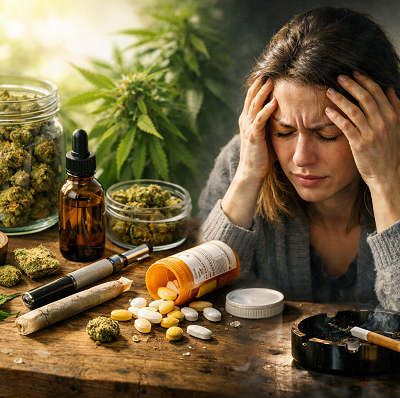

Cannabis and Anxiety: Who It Helps — and Who It Doesn’t
There has been considerable growth in the popularity of cannabis in recent years, as there has been an increasing amount of discussion about its potential therapeutic uses — including its potential to treat anxiety disorders. Anxiety disorders represent the most prevalent group of mental health disorders within the United Kingdom, and the vast majority of people who suffer from these disorders will be impacted at some point during their lives, regardless of age or socioeconomic status.
Research and clinical experience indicate that the effect of cannabis on anxiety disorders is complex — and therefore, difficult to generalize. The primary way that cannabis affects the human body is via the endocannabinoid system (ECS) — which regulates mood, stress response, sleep, and emotional equilibrium.
The two most commonly referenced compounds found in cannabis — Tetrahydrocannabinol (THC), and Cannabidiol (CBD) — exhibit very different characteristics regarding their impact on anxiety disorders.
Cannabidiol (CBD), is generally considered to promote a calming effect — thereby acting as an anxiolytic agent — although, the degree to which this occurs is directly related to dosage, context, and the individual’s sensitivity to CBD.
For individuals with mild to moderate anxiety — especially social anxiety — a CBD-dominant cannabis product may assist with reducing nervousness, improving sleep quality, and reducing feelings of discomfort in social situations. Due to the non-intoxicating properties of CBD, it is also significantly less likely to cause unpleasant psychological side effects when compared to THC.
Tetrahydrocannabinol (THC), on the other hand, represents a far more complex picture. Low doses of THC may help some individuals relax — and temporarily alleviate stress — however, high doses of THC can increase heart rate, heighten anxious thinking, and evoke panic attacks — especially in individuals who are predisposed to experiencing anxiety, or who have limited experience with cannabis.
Cannabis may either positively — or negatively — affect anxiety disorders based upon several factors:
- The proportion of THC to CBD found in the product being consumed
- Dosage and frequency of consumption
- Individual differences in brain chemistry and mental health history
- Setting — and frame of mind — in which cannabis is being used
- Age — and sensitivity to psychoactive substances
It is important to note that cannabis is not an appropriate treatment option for every person suffering from anxiety disorders. In particular, individuals with a history of panic disorder, psychosis, or severe anxiety disorders may experience exacerbation of their symptoms — particularly if they consume THC-dominant cannabis products. Therefore, medical professionals and caregivers must provide accurate and objective guidance — and close monitoring — to ensure safe and effective use of cannabis when it is prescribed.
At present, cannabis-based medicinal products intended to address mental health issues are subject to very restrictive guidelines in the United Kingdom — which reflects the necessity for stronger scientific evidence to establish safety and efficacy. While cannabis may provide symptomatic relief for some people — it is not a “one size fits all” treatment — and should never replace conventional, professionally supervised mental health care.
Further research into the therapeutic potential of cannabis is expected to continue — and determining who cannabis will benefit — and who it will not benefit — is critical to providing responsible access to these products.
Stay with our blog about cannabis to know more.